Coming Soon
Shoulder Ultrasound in Clinical Practice
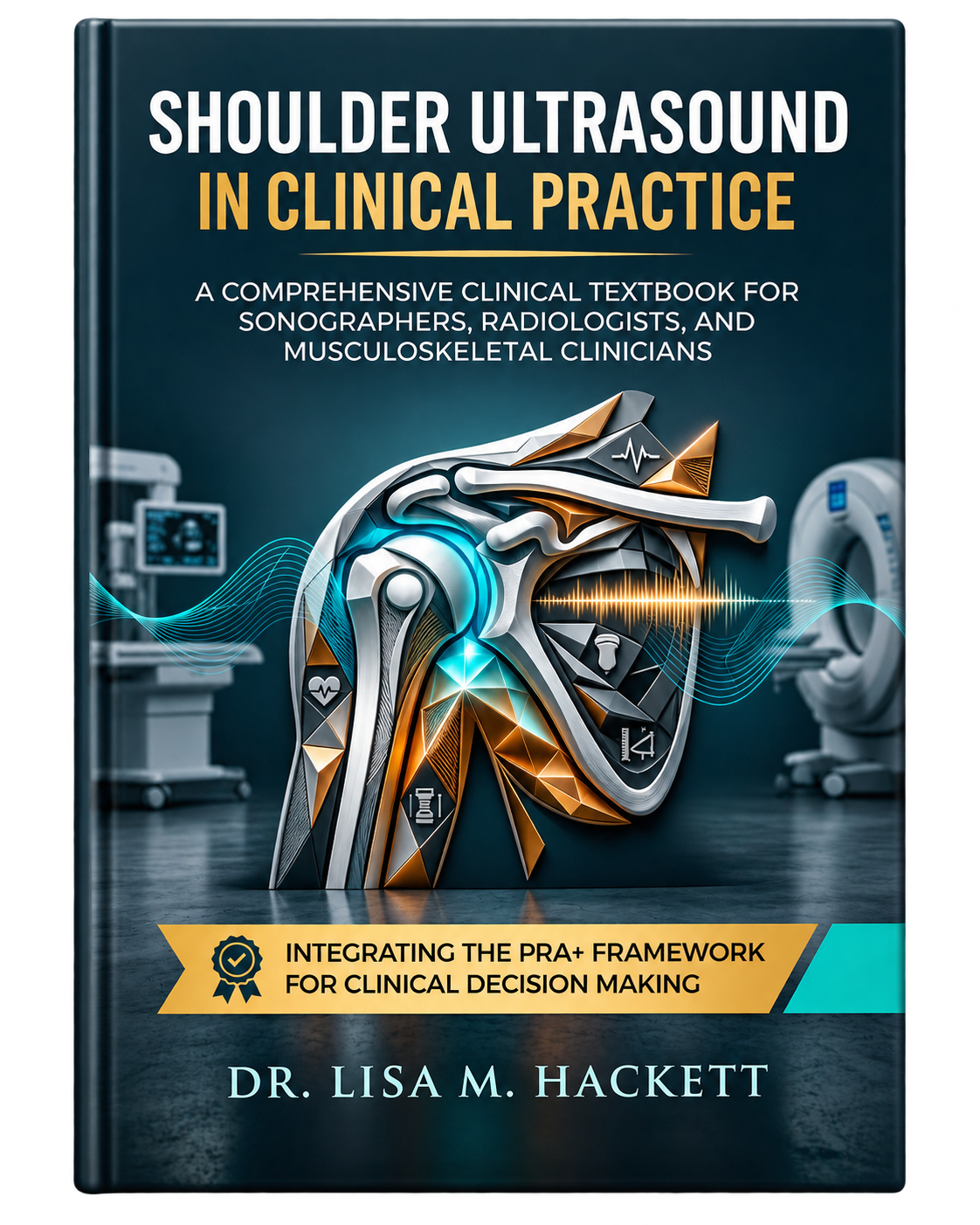
The shoulder textbook that teaches you how to think, not just what to look for.
You can capture a perfect image and still get the diagnosis wrong. Most errors in shoulder ultrasound are not failures of imaging. They are failures of reasoning.
This book fixes that.
Written by Dr Lisa M Hackett, one of Australia's leading musculoskeletal specialist sonographers, this textbook is designed for students and clinicians who want to scan with confidence, interpret with precision and report with authority.
Why good scanners still miss things
A tear on screen is not always the cause of pain. An anisotropy artefact can look like pathology. A report can describe everything and still leave the treating team unsure what to do next.
Most textbooks teach you anatomy and pathology. Very few teach the reasoning that connects them to the right clinical decision.
That gap is where diagnostic errors live, and it is exactly what this book was written to close.
WHAT MAKES THIS BOOK DIFFERENT
A framework you will use on every scan.
The PRA+ Framework gives you a clear way to think through every finding, from the image to the report.
Protocols developed through original research.
The book includes the UNSW shear wave elastography protocol developed through Dr Lisa M Hackett's research, alongside her validated protocol for assessing the repaired rotator cuff. These protocols reflect Lisa's own research programme and clinical expertise.
Written by someone who does all three.
Lisa scans, researches and teaches, so every chapter connects the evidence to what actually happens in the scanning room.
Useful from your first scan to specialist practice.
Students get a clear, structured foundation. Experienced clinicians get the depth and nuance to sharpen their edge.
THE PRA+ FRAMEWORK
Four questions. Every scan, every time.
P: Precision. Is this image technically fit to answer the clinical question?
R: Reasoning. What does this finding actually mean in this patient?
A: Action. What should it trigger, and is that decision proportionate?
+: Communication. Will the report lead the treating team to the right decision?
Simple enough to learn as a student. Rigorous enough to use for a whole career.
WHAT YOU WILL BE ABLE TO DO
By the end of this book, you will be better equipped to:
Perform a systematic, reproducible shoulder examination every time.
Tell true pathology apart from artefact and age-appropriate change.
Grade rotator cuff tears with confidence.
Assess post-operative shoulders using a validated protocol.
Understand where shear wave elastography adds real clinical value.
Guide shoulder procedures with precision.
Write reports that lead to the right decision and stand up to scrutiny.
INSIDE THE BOOK
Explore a comprehensive approach to shoulder ultrasound, including:
Clinically oriented anatomy, including an in-depth chapter on the anterior supraspinatus insertion.
Rotator cuff, biceps, bursal, labral, AC joint, nerve and rheumatological pathology.
Adhesive capsulitis, instability and the athletic shoulder.
Ultrasound-guided procedures, from bursal injection to barbotage.
Post-operative assessment and shear wave elastography.
Reporting standards and medicolegal considerations.
Appendices with normal reference values, tear grading and an examination checklist.
WHO IT IS FOR
For students
Learn the shoulder the right way from the start. This book takes you from anatomy and physics to a confident, systematic scan, and builds the clinical reasoning habits that usually take years of supervised practice to develop.
For clinicians
Sharpen your interpretation, reduce uncertainty and write reports your referrers trust. Whether you scan, report or act on the findings, this book will change how you read a shoulder.
Written for sonographers, radiologists, sports physicians, physiotherapists, orthopaedic surgeons, general practitioners and students in musculoskeletal ultrasound.
ABOUT THE AUTHOR
Learn from the researcher behind the protocols
Dr Lisa M Hackett has spent over three decades in clinical ultrasound practice, research and education.
She holds a PhD and a Master of Medicine from UNSW, where she is an Associate Conjoint Lecturer, and her doctoral research focused on rotator cuff repair assessment using shear wave elastography.
With more than 45 peer-reviewed publications and a career spent training clinicians nationally and internationally, Lisa has distilled her clinical experience, research and teaching expertise into one practical, evidence-based textbook.
EARLY ACCESS
Shoulder Ultrasound in Clinical Practice is almost here.
Join the early access list and you will be the first to know when it is released, along with any launch offers.